
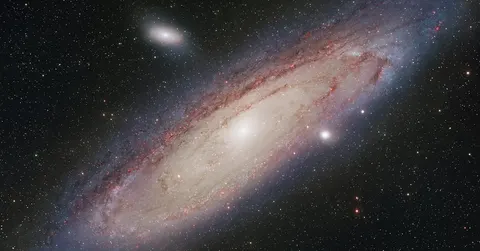
Space should be blindingly bright. Not dim, not speckled, but bright: every square inch of the night sky blazing like the surface of the sun, no gaps, no constellations, no darkness to see the stars against. That is what the arithmetic says should happen in a universe with stars going on forever. Step outside and it plainly doesn't. So why is space black, when there is so much burning in it?
Space is black because the universe hasn't been running long enough
The night sky is dark because the universe has a finite age. Light moves fast but not instantly, and the universe is roughly 13.8 billion years old, so we can only see the stars whose light has had time to arrive. Everything past that boundary is dark to us not because it is empty, but because its light is still in transit and always will be. Cosmic expansion piles on, stretching the light from the most distant galaxies until it drops out of the range our eyes can register.
That answer took about three centuries to arrive, and the question that forced it is one of the tidiest arguments in science.
Kepler saw the problem in Galileo's telescope
In 1610 Galileo published Sidereus Nuncius and reported that his telescope had found thousands of stars nobody knew were there. Johannes Kepler read it and, instead of being delighted, got suspicious. He wrote back to Galileo that the more stars you find, the worse it gets: every new one strengthened his argument that the universe could not be infinite.
His logic was simple. If the universe is endless and evenly stocked with stars, then pick any direction at all and follow that line outward. It has to hit a star eventually. Maybe it takes a hundred light years, maybe a hundred billion, but in an infinite field of stars there is no direction where you can thread the needle forever. Distant stars look fainter, yes, but there are correspondingly more of them at each distance, and the two effects cancel. Every point in the sky lands on a stellar surface, so every point should be as bright as one.
Edmond Halley and Jean-Philippe Loys de Cheseaux sharpened the argument in the 1700s. Heinrich Olbers described it in 1823 and got his name permanently attached to it, although he was nowhere near the first to pose it. It has been Olbers' paradox ever since, which is one of history's more casual injustices.
The dust theory that heated itself to death
Olbers had an answer, and it is the one almost everyone reaches for first: something in between must be blocking the light. Clouds of dust and gas, soaking up the glare from the far side of the universe.
It is a good instinct and it is wrong, for a reason that only shows up when you think about heat. Dust that absorbs starlight does not quietly hold onto it. It warms up. Keep pouring in an infinite amount of starlight and the dust keeps warming until it reaches the same temperature as the stars themselves, at which point it glows exactly as brightly as the objects it was supposed to be hiding. The curtain becomes the light. You cannot hide an infinite sky behind anything, because anything you put in front of it eventually catches fire.
That is what made the paradox so stubborn. It was not a puzzle about telescopes or dust or the limits of human vision. It was telling astronomers that one of their assumptions about the universe was flatly false, and nobody could work out which.
A poet got there first
The first person to write down something close to the modern answer was not an astronomer. It was Edgar Allan Poe, in Eureka, a strange book-length prose poem he published in 1848, a year before he died.
Poe rejected the dust idea and reasoned his way to the void instead. "Were the succession of stars endless, then the background of the sky would present us an uniform luminosity, like that displayed by the Galaxy", he wrote, laying out the paradox exactly as Kepler had. Then came his move. The only way to explain the dark gaps between the stars, he said, was "by supposing the distance of the invisible background so immense that no ray from it has yet been able to reach us at all."
Read that again. Has yet been able. Poe is saying the darkness is not an absence of stars. It is a delivery delay. The light is coming, it just hasn't landed. He had no data, no redshift, no expanding universe, nothing but Newton and nerve, and he anticipated the qualitative shape of the real solution eighty years before Hubble. Almost nobody took the book seriously at the time, including the scientists.
Expansion pulls the rest of the light out of sight
Poe was missing half of it, because the universe turned out to be doing something he had no way to guess: expanding. As space stretches, the light crossing it stretches too. Wavelengths get longer, colors slide toward the red, and the energy per photon drops. Light from the most distant galaxies gets pulled so far that it exits the visible band entirely.
So the far universe is doubly hidden. Most of it is beyond the horizon set by 13.8 billion years of light travel. Much of what is inside the horizon has been redshifted into wavelengths your retina cannot register. The two effects overlap enough that the bookkeeping gets argued over. In principle the redshift alone would darken the sky even in a universe of infinite age, but the finite age is what does the visible work: it caps how many stars can be in the sky at all, and there simply hasn't been time to fill it. The first stars didn't even switch on until several hundred million years in, so the sky was black for a while before there was anything to make it otherwise. This is worth sitting with when you think about how big the universe is or how old the universe is: both numbers are also limits on what you are permitted to see.
The sky is glowing after all
Here is the part that turns the whole thing inside out. Kepler was right.
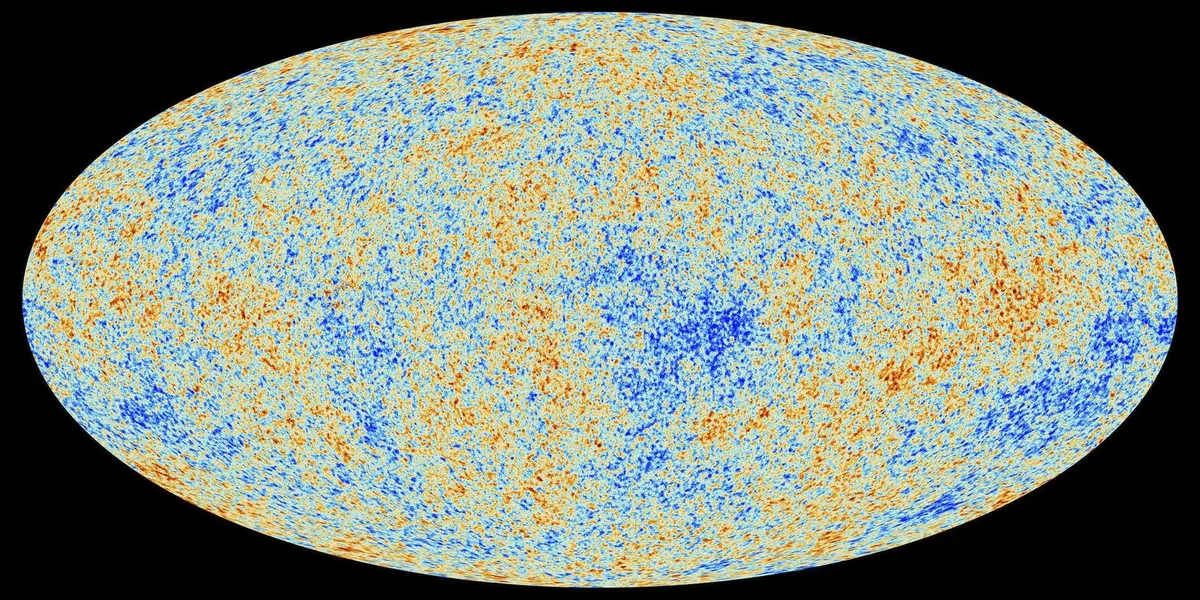
Every line of sight really does end on something hot. Follow any direction far enough and you eventually run into the moment, about 375,000 years after the Big Bang, when the universe cooled enough for light to travel freely. That surface surrounds us in every direction, and it was searing. But the light from it has been stretching for 13.8 billion years, and it now arrives as microwaves at about 2.7 degrees above absolute zero, the cosmic microwave background. ESA's description of the moment it was recognized is blunt about how strange it looked: "It apparently came from everywhere with the same intensity, day or night, summer or winter."
The sky is uniformly bright. It always was. Point a microwave telescope anywhere, at the emptiest black patch you can find between the stars you watch twinkle, and it is not empty at all, it is glowing, evenly, at a temperature that also happens to be why space is so brutally cold.
The blackness overhead is not the universe being empty. It is a redshift, hiding an all-sky fire behind a wavelength your eyes were never built to catch. You are staring at the Big Bang every clear night. It just looks like nothing.
Keep wondering: the darkness is a clock, so it helps to know how old the universe is and how big it got; for a sky that goes the other way and turns a color for an entirely different reason, see why the sky is blue; and for something that stays genuinely dark no matter what you point at it, there are black holes and how they die.


Join the conversation
Comments are reviewed before they appear. Be kind and stay curious.
Loading comments…