
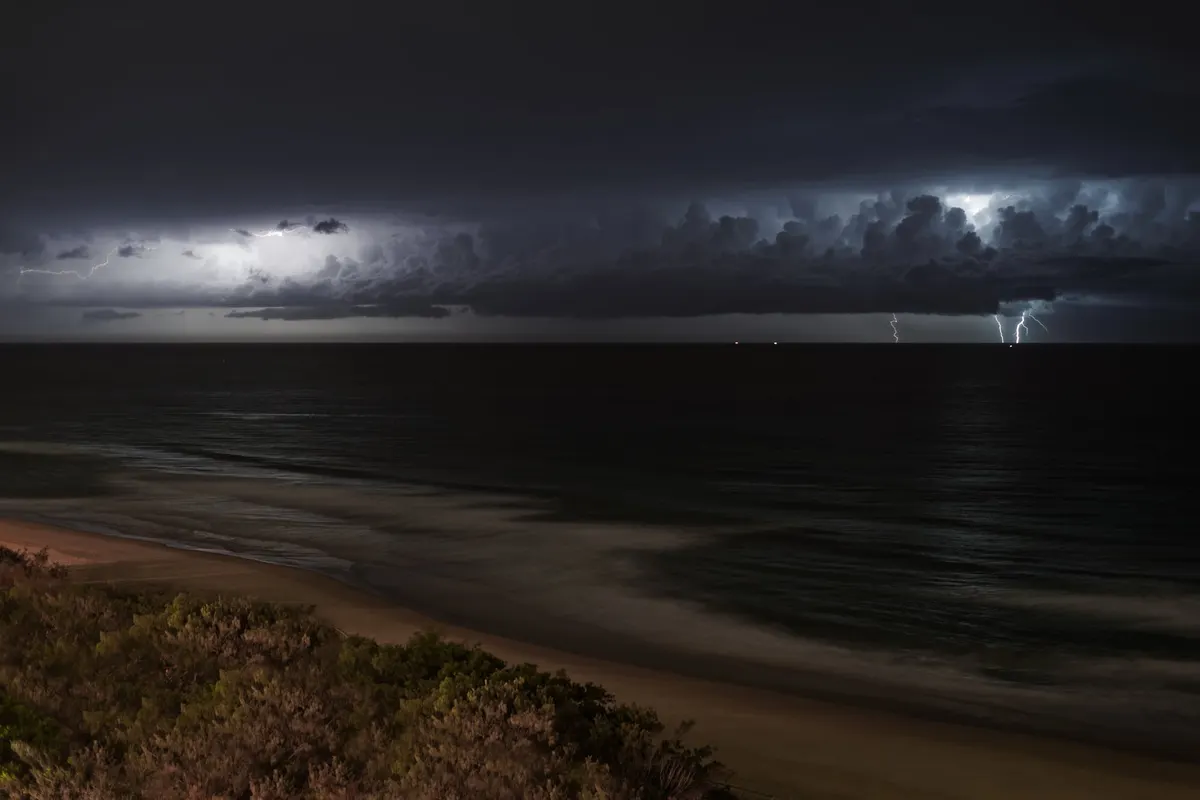
Does a bolt of lightning hitting the sea kill every fish for miles? It sounds like it should. Hundreds of millions of volts, an ocean of salt water, and salt water conducts electricity beautifully. The image assembles itself: a flash, then a slick of dead fish spreading outward like a bruise. What happens when lightning strikes the ocean is a great deal less than that, and a great deal more pointed at you than at the fish.
The ocean gets hit all the time, and the fish, almost all of them, carry on eating breakfast. The part that should worry you is not where the fish are. It is where your head is.
The strike spreads sideways across the surface instead of sinking
When lightning strikes the ocean, most of the electrical discharge happens near the water's surface and spreads outward across it rather than plunging toward the seafloor (National Weather Service). Before the bolt arrives, charge has already been gathering along that surface, and that is where the energy stays. NOAA describes it plainly: the strike spreads out over the water, which acts as a conductor, and it can electrocute fish that are near the surface (NOAA Ocean Today).
Near the surface. That is the whole story in two words. The bolt is genuinely lethal, but it is lethal in a thin film, and the ocean is not a thin film. It averages several kilometres deep in the open basins, and a fish hanging even a modest distance down is sitting outside the part that got hit. Read that against how deep the ocean actually is and the myth starts to look silly. You could lose the entire lethal layer in the first blink of the water column. But read it the other way and it stops being funny: the fish survive by being under the dangerous layer, and a swimmer, head and shoulders up in the air, is not under it. A swimmer is in it.
Salt water is so good at conducting that it hogs the current
Here is the part that flips the intuition inside out. The reason people expect carnage is that seawater conducts well. That is true, and it is exactly why the carnage doesn't happen.
Pure water is an excellent insulator and barely conducts at all. What makes any real water conductive is the dissolved ions moving through it, which is why the sea, loaded with sodium and chloride, is in a different class from a mountain stream (USGS). If you want the backstory on where all that salt came from, that is its own long argument with the rocks. Measured properly, the global ocean averages a conductivity of 3.31 siemens per meter by volume, and surface values swing widely with temperature and salinity (Tyler et al., Earth, Planets and Space). Fresh water sits far below that.
Now the twist. The USGS puts it about as bluntly as a government hydrology page ever puts anything: when water holds very large amounts of ions, it becomes such an efficient conductor that a current may essentially ignore a human body in the water and stick to the better pathway, the masses of ions around it. Their conclusion is that the danger of electrocution in seawater is lower than it would be in bathwater. A body is a mediocre wire compared to the Atlantic. The current has somewhere better to be.
That is a comparison, not a clean bill of health, and I want to be clear about which one it is. Lower risk than a bathtub full of live current is not the same as safe.
Nobody can tell you how far the danger reaches, and pretending otherwise is worse
This is where a lot of articles quote you a tidy radius for water. Twenty metres. A hundred. Pick one. Chase those numbers back and almost none of them have a primary source behind them.
There is one real measurement nearby, and it is worth knowing precisely because of what it is not. The National Weather Service reports that radial horizontal arcing has been measured at least 20 m from the point where lightning hits ground. That is land, not sea, and nobody has established the equivalent for water. On water the same agency says only that scientists don't know exactly just how deep the lightning discharge reaches, and follows it immediately with the warning that it's very dangerous to be swimming or boating during a thunderstorm. The honest answer is that the current spreads out from the strike point and weakens with distance, and the useful safety margin is not a number anyone has published. So the guidance skips the arithmetic and goes straight to the instruction: when you hear thunder, get out of the water.
The people lightning actually kills are standing in the shallows
The fish myth survives partly because it points the fear in the wrong direction. Lightning over water kills people, and it does it in a specific, boring, preventable way.
From 2006 through 2019, lightning killed 418 people in the United States, and almost two thirds of them were doing something recreational (Jensenius, National Weather Service). Water-related activities topped the list. Fishing alone accounted for 40 deaths, four times as many as golf, with 25 at the beach and 18 boating. Fishing made up 44 percent of the water-related deaths, boating another 20 percent, beach activities about 28 percent, and swimming about 8 percent.
Notice what those people have in common. They are not deep. They are the tallest object on a flat plain, sitting in the open, with a motor or the surf drowning out the thunder, and no way to reach a building in the ninety seconds they suddenly need. NOAA points out that lightning can strike from 10 miles away, which means the sky above you can look survivable right up until it isn't (NOAA). The fish are safe because they are below. Nobody in that list was below. Stand on a boat or a jetty and you are the tallest thing for a mile; swim, and you are lying in the exact skin of water the current runs through. There is no version of being in the sea that puts you where the fish are.
The sea does get hit less than the land, which is the one piece of luck in this. Solid ground soaks up sunlight and heats faster than water, driving the stronger convection that builds storms (NASA Earth Observatory), so the enormous weight of water a storm cloud carries gets stacked over continents more readily than over open ocean. It is a difference in odds, not in outcome.
What I like about this one is how completely the fear inverts. We imagine electricity as something that hunts through water for a body to ruin, the way static builds and jumps to your fingertip, or the way an electric eel aims a pulse at prey. Lightning at sea does the opposite. It lands, it fans out across a skin of salt water it likes far more than it likes flesh, and it dies. The sea absorbs the biggest electrical event on the planet the way a room absorbs a shout. The fish are fine, because the fish had somewhere to be. That skin of water it fans across is the one part of the ocean a person is ever actually in, which is why the only number worth carrying out of all this is zero: the number of seconds you should stay in the water once you hear thunder.
Keep wondering: the same storm cloud that fires the bolt is holding up an astonishing tonnage of water, which is how much a cloud weighs and eventually why it rains; the ions that make the sea such a willing conductor are there because of why the ocean is salty; and the fish riding out the flash a few metres down are busy breathing water.

Join the conversation
Comments are reviewed before they appear. Be kind and stay curious.
Loading comments…