
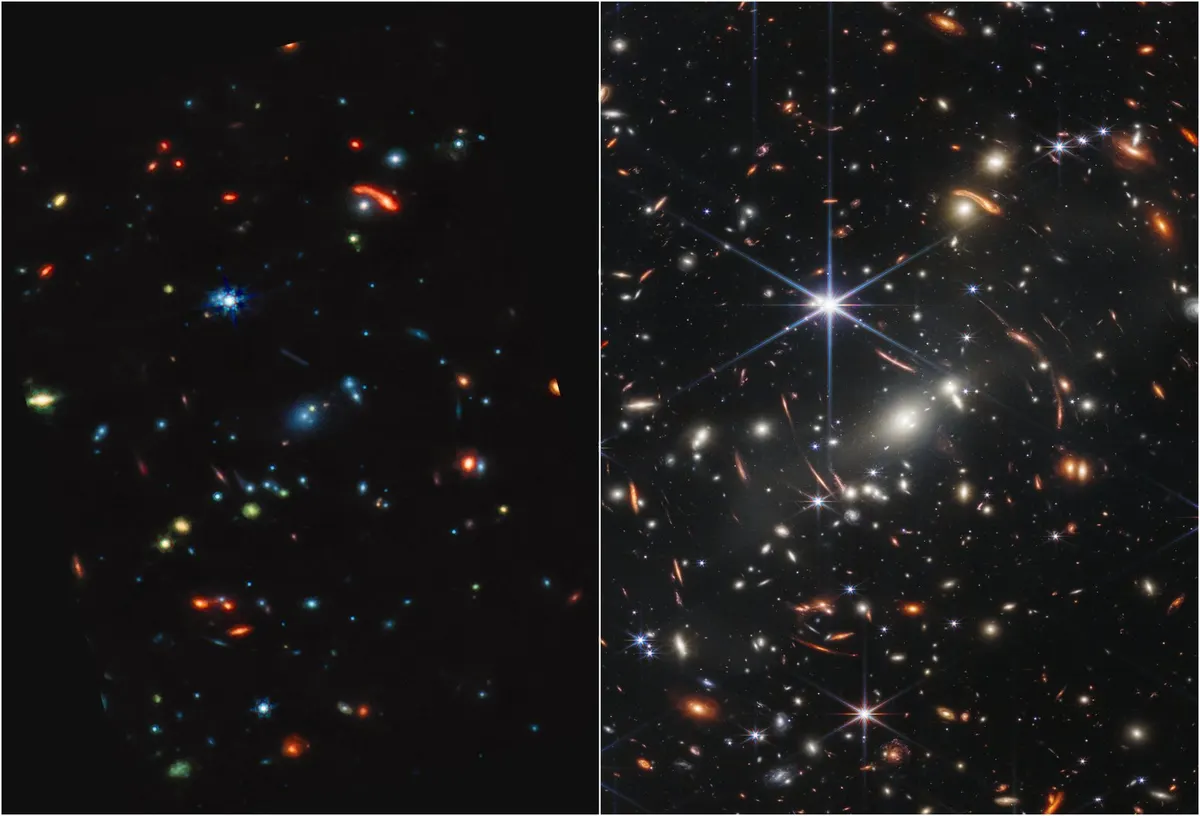
What is outside the universe? Every kid asks it, and most adults never stop quietly wanting the answer. The logic feels airtight: if the universe is expanding, it has to be expanding into something. If it started small and got big, there has to be a somewhere it got big inside of. The reply from cosmology is stranger than either a yes or a no. The question may be broken before you finish asking it.
There may be no outside, and that is not a dodge
The universe is defined as everything that exists, which makes "what is outside it" closer to asking what is north of the North Pole than to asking what is behind your garden wall. NASA's definition leaves no room for a beyond: "The universe is everything. It includes all of space, and all the matter and energy that space contains." Anything we found past the universe would stop being outside and simply join the inventory. "Outside" is a spatial word, it needs space to be outside in, and space is precisely the thing you are trying to get outside of. No instrument reaches past that, so science does not get to answer. It only gets to say that nothing in physics needs an outside.
The universe is not an object sitting in a room
Our intuition about outsides was built on Earth, where everything has one. A balloon sits in a room, and the room sits in a building. Each of those things is embedded in something larger, so each has a beyond.
The universe is not known to be embedded in anything. General relativity, which is the theory doing the heavy lifting here, describes the geometry of spacetime from the inside. Curvature, distance, the paths light takes: all of it is defined by measurements you could in principle make without ever stepping out. There is no external stage the universe is standing on in the math. Physicists did not remove the outside to be difficult. It was never needed, and no observation has ever asked for it back.
Expansion is a stretch, not an explosion
The strongest push toward "outside" comes from expansion. Galaxies are flying apart, so surely the whole thing is a swelling ball inside a bigger emptiness.
It isn't. Cosmic expansion is intrinsic, meaning it happens to the distances themselves. As the standard description puts it, expansion "does not mean that the universe expands into anything or that space exists outside it". Nothing is being pushed outward through a void. The separations between things are simply getting longer everywhere at once. Nicole Granucci, a physics instructor at Quinnipiac University, gives the blunt version: "the universe doesn't have anything to expand into. It just expands into itself."
The balloon analogy gets used constantly here, and it is useful right up until it betrays you. Draw dots on a balloon, inflate it, and every dot moves away from every other dot without any dot travelling across the rubber. That part is right. The trap is everything the analogy smuggles in for free: the air inside, the room the balloon is sitting in, your hands. In the analogy, the balloon's two-dimensional skin is the entire universe. The room is not a distant part of the cosmos. It is scaffolding you needed to picture the thing at all.
The edge you can almost see is a deadline, not a wall
There is a boundary out there, and it fools people constantly. The observable universe is a sphere roughly 93 billion light-years across, its far edge about 46.5 billion light-years away in every direction. That sounds like the rim of everything.
It isn't a rim. It's a deadline. That boundary is a horizon set by two mundane facts: light travels at a finite speed, and the universe has only been around for about 13.8 billion years, which is an age we can now measure with real precision. Light from anything further out has not had time to arrive. The horizon is not fixed in space either. It is centered on you. A civilization in a galaxy near our horizon has its own horizon, centered on them, taking in vast stretches we will never see. As the astronomical summary of it goes, "no evidence exists to suggest that the boundary of the observable universe constitutes a boundary on the universe as a whole." What you're looking at when you look "out to the edge" is not the end of the universe. It's the end of the mail that's been delivered so far, which is why the question of how big the universe really is has no confident answer.
Finite would not save the idea anyway
Suppose the whole universe turns out to be finite. Wouldn't that force an edge, and something past it?
No. A finite space can have no boundary at all. The surface of the Earth is the standard demonstration: finite area, no edge anywhere on it, walk in one direction forever and you never fall off, you come back to where you started. Stephen Hawking used exactly this picture for spacetime in his lecture on the beginning of time, describing a universe that is "finite in extent, but without boundary," like the surface of the Earth "but with two more dimensions."
A wrapped-around universe like that would leave fingerprints: the same patch of sky showing up twice, matched circles in the cosmic microwave background where your line of sight has gone all the way around and come back. The Planck satellite team went looking for those matched circles and found nothing. No evidence for a multiply-connected universe, and a lower limit saying that if space does wrap, the wrap is bigger than the region we can see. Whether the universe is finite or infinite is genuinely still open. Either way, "edge" is not what falls out of it.
Where "outside" earns its place back
Now the honest complication. Some serious physics does hand the word "outside" a real job. In eternal inflation, our entire universe is one bubble that stopped inflating inside a larger region that never stopped. If that picture holds, there is an outside, and it is full of other bubbles.
This is not a thought experiment nobody has bothered to test. In 2011, Stephen Feeney, Matthew Johnson, Daniel Mortlock and Hiranya Peiris ran what they called the first observational tests of eternal inflation, combing WMAP's map of the cosmic microwave background for the disc-shaped scars another bubble would leave if it had collided with ours. They found no reason to add them, reporting that "the WMAP 7-year data do not warrant augmenting LCDM with bubble collisions." A null result. Not a disproof, just silence. If we are in a bubble, nothing has hit us hard enough to leave a mark we can read.
That is where the multiverse sits: a consequence of theories that are testable in other ways, describing regions that may be permanently unreachable, with no positive evidence yet. It is a live idea. It is not a finding.
What we are actually allowed to say
Settled: expansion requires no outside, the cosmic horizon is a limit on our eyesight rather than a wall, and the universe extends past everything we can see. Unsettled: whether "outside the universe" refers to anything at all. Untestable so far: the other bubbles, if they exist.
The question keeps its grip because we were assembled by evolution inside rooms, and every room any of us has ever been in had a wall with something behind it. Cosmology's answer isn't that the wall is very far away. It's that the wall may be a piece of Earth furniture we packed for a trip where it does not apply. Physics has form here: it already told us time runs slower near a black hole and that the darkest objects in the cosmos evaporate. By that standard, "outside" turning out to be a local convenience is a fairly ordinary Tuesday.
Keep wondering: the horizon question runs straight into how big the universe actually is and how long it has been here, and if you want the other place where physics stops describing an "over there," start with what is on the other side of a black hole.

Join the conversation
Comments are reviewed before they appear. Be kind and stay curious.
Loading comments…